Description
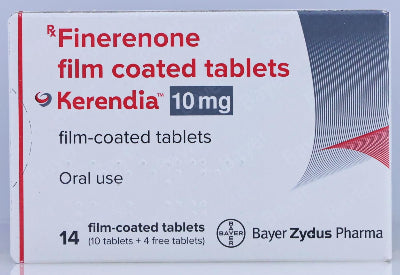
Kerendia 10 mg (Finerenone) – Oral Therapy to Reduce Kidney & Cardiovascular Risk
Kerendia 10 mg contains finerenone, a non-steroidal mineralocorticoid receptor antagonist that reduces risk of kidney function decline, kidney failure, cardiovascular death, heart attack, and heart failure hospitalization in adults with chronic kidney disease associated with type 2 diabetes.
Key Benefits:
- Slows CKD progression in type 2 diabetes
- Reduces cardiovascular death, MI, and HF hospitalizations
- Once‑daily dosing with or without food—simplifies adherence
How It Works
Finerenone blocks mineralocorticoid receptors in heart, kidney, and blood vessels—reducing inflammation and fibrosis that contribute to cardiorenal disease.
Recommended Dosage
Initial dose is based on kidney function: • If eGFR ≥ 60 mL/min/1.73 m² → 20 mg once daily • If eGFR 25–<60 mL/min/1.73 m² → 10 mg once daily Target dose is 20 mg once daily.
Monitoring & Adjustments
- Check serum potassium and eGFR before starting; do **not** initiate if potassium > 5.0 mEq/L
- Recheck potassium 4 weeks after initiation/dose change and periodically thereafter; adjust dose as needed per potassium level
Common Side Effects
- Hyperkalemia (elevated potassium)—most common (>10%) ([turn0search16],
- Hypotension (low blood pressure), hyponatremia (low sodium)
Precautions & Interactions
- Contraindicated with serum potassium > 5.0 mEq/L or adrenal insufficiency
- Avoid strong CYP3A4 inhibitors/inducers (e.g. ketoconazole, grapefruit juice)—may increase risk or reduce efficacy
- Not recommended in severe hepatic impairment (Child‑Pugh C) or eGFR <25 mL/min/1.73 m²
- Breastfeeding is not recommended—avoid use 1 day after last dose
Why Choose Kerendia?
- Bayer’s first‑in‑class oral MR antagonist with proven cardiorenal benefits
- Backed by robust RCT evidence (FIDELIO‑DKD, FIGARO‑DKD) involving >13,000 patients
- Oral, once-daily tablet with predictable effects and manageable safety profile
Frequently Asked Questions (FAQs)
1. Who is eligible for Kerendia 10 mg?
Adults with CKD associated with type 2 diabetes (eGFR ≥25); dosing is adjusted based on eGFR and serum potassium levels.
2. What reactions require dose adjustment?
If potassium >4.8–5.0 mEq/L, maintain or reduce dose; if >5.5 mEq/L, withhold treatment and restart at lower dose once potassium ≤5.0 mEq/L.
3. What if a dose is missed?
Take missed dose the same day if possible; skip it if missed beyond that—do not double dose next time.
4. Can Kerendia be taken with food?
Yes—clinically irrelevant effect of food on absorption—can be taken with or without meals.
5. What monitoring is required?
Baseline and serial monitoring of serum potassium and eGFR; liver function may require monitoring in moderate hepatic impairment.