
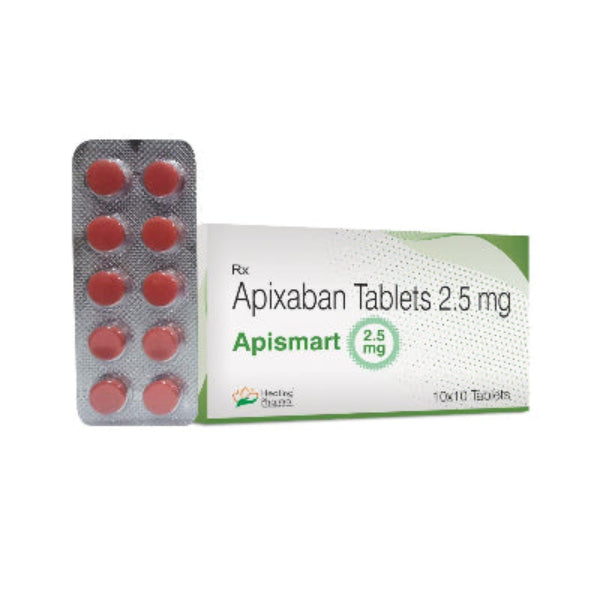
Apismart 2.5 mg (Apixaban)
Apismart 2.5 mg contains apixaban, a direct oral anticoagulant (DOAC) that selectively inhibits factor Xa. The 2.5 mg tablet represents a reduced-dose option used in specific clinical situations — for example as a dose reduction in certain patients with atrial fibrillation (AF) meeting prespecified criteria, or as an extended secondary prevention dose to lower the risk of recurrent venous thromboembolism (VTE) after initial treatment. Apismart is a prescription medicine and must be used under clinician supervision because of bleeding risk and potential drug interactions.
Product introduction
Apixaban provides predictable anticoagulation with rapid onset of action and does not usually require routine laboratory monitoring of anticoagulant effect. The 2.5 mg strength allows clinicians to tailor anticoagulation intensity for patients at higher bleeding risk or for long-term secondary prevention where full-dose therapy may be unnecessary or unsafe.
Uses of Apismart 2.5 mg (Apixaban)
Common scenarios where the 2.5 mg dose may be used (clinician-determined):
- Dose reduction in atrial fibrillation: recommended for some patients who meet dose-reduction criteria (for example advanced age, low body weight, or impaired renal function) — follow local product labelling and prescriber advice.
- Extended prevention of recurrent DVT/PE: lower-dose apixaban (2.5 mg twice daily) is often used after completing initial therapeutic anticoagulation to reduce recurrence risk while minimising bleeding risk.
- Other specialist-directed situations: as part of an individualized anticoagulation plan balancing thrombotic and bleeding risks.
Note: Exact indications, dose regimens and duration depend on the clinical context and local guidelines. Always follow your prescriber’s instructions.
Benefits of Apismart 2.5 mg
- Lower bleeding risk vs full-dose in selected patients: reduced-dose strategies can reduce bleeding while maintaining adequate protection in appropriate patients.
- Convenient oral dosing: predictable pharmacokinetics without routine INR monitoring for most patients.
- Flexible management: allows clinicians to step down intensity for long-term secondary prevention of VTE or when patient characteristics warrant dose reduction in AF.
Recommended dosing
Typical examples (individualised by clinician):
- Atrial fibrillation (dose reduction): dose reduction to 2.5 mg twice daily is considered when patients meet established criteria (e.g., two or more of: age ≥80 years, body weight ≤60 kg, serum creatinine ≥1.5 mg/dL or other local renal criteria) — follow local product labelling and prescriber guidance.
- Extended VTE prevention: common regimen is 2.5 mg twice daily after completing initial therapeutic anticoagulation (duration individualised based on risk).
- Take at the same times each day, with or without food. Do not change dose or stop without consulting your clinician.
Side effects of Apismart 2.5 mg (Apixaban)
The main risk with any anticoagulant is bleeding. Even at reduced doses, any unexplained bleeding should prompt urgent assessment.
Common side effects
- Minor bleeding (bruising, nosebleeds, gum bleeding)
- Increased menstrual bleeding
- Occasional gastrointestinal discomfort
Serious risks: major bleeding (e.g., gastrointestinal bleeding, intracranial hemorrhage), bleeding requiring hospitalization or transfusion, and hypersensitivity reactions. Seek immediate medical attention for heavy bleeding, black/tarry stools, vomiting blood, sudden severe headache or focal neurological symptoms, fainting or unexplained severe weakness.
How to use Apismart 2.5 mg
- Take exactly as prescribed by your clinician — do not self-adjust dose.
- Typical regimen when indicated: 2.5 mg twice daily (morning and evening), taken at the same times each day.
- Swallow tablets whole with water; do not crush unless advised.
- If you are due for a procedure, do not stop or change anticoagulation without specialist advice — timing of interruption depends on bleeding risk, renal function and procedure type.
- If vomiting occurs soon after dosing, contact your prescriber for advice.
How Apismart works
Apixaban selectively and reversibly inhibits factor Xa, reducing conversion of prothrombin to thrombin and thereby decreasing thrombus formation. The mechanism is the same as higher-strength tablets; the 2.5 mg tablet simply provides a lower daily anticoagulant exposure when used twice daily.
Safety advice
| Bleeding risk | Inform all healthcare professionals, including dentists, that you take apixaban. Avoid NSAIDs and other medicines that increase bleeding risk unless approved by your clinician. Use caution with activities that raise the risk of traumatic injury. |
| Renal impairment | Dose adjustments and choice of agent depend on kidney function — your prescriber will assess and monitor renal function as required. |
| Liver disease | Use with caution in significant hepatic impairment; apixaban may be contraindicated in severe liver disease with coagulopathy. |
| Drug interactions | Avoid strong combined P-gp and CYP3A4 inhibitors (e.g., certain azole antifungals, ritonavir) or inducers (e.g., rifampicin) unless specialist manages therapy. Always provide your prescriber with an up-to-date list of medicines and supplements. |
| Pregnancy & breastfeeding | Apixaban is usually avoided in pregnancy; breastfeeding decisions should be made with specialist advice. |
| Reversal | For life-threatening bleeding, specific reversal strategies exist in hospital settings—seek emergency care immediately for major bleeding. |
What if you forget a dose?
- If you miss a dose, take it as soon as you remember on the same day and continue the usual schedule.
- Do not double doses to make up for a missed one.
- If you miss more than one dose, contact your clinician for instructions.
All substitutes
Other anticoagulant options and strategies (choice depends on indication and patient factors):
- Other DOACs (rivaroxaban, dabigatran, edoxaban) with indication-specific dosing
- Warfarin (requires INR monitoring) — may be preferred in some clinical situations
- LMWH (low-molecular-weight heparin) for certain indications or bridging
Quick tips
- Carry an anticoagulant alert card or wear medical identification stating that you take apixaban.
- Tell your surgeon, dentist or emergency clinician you take apixaban before any procedure.
- Avoid over-the-counter NSAIDs and herbal supplements that increase bleeding risk unless cleared by your clinician.
- Discuss travel, pregnancy plans and vaccinations with your clinician if you are on long-term anticoagulation.
Fact Box
| Generic name | Apixaban |
| Brand | Apismart 2.5 mg |
| Drug class | Direct Factor Xa inhibitor (DOAC) |
| Form | Oral tablet (2.5 mg) |
| Typical dosing | 2.5 mg twice daily when used as a reduced dose in AF or for extended VTE prevention (clinician-determined) |
| Prescription | Required — specialist or prescribing clinician oversight recommended |
Patient concerns
Will the lower dose still protect me? In patients selected for reduced-dose apixaban (for AF) or for extended VTE prevention, the 2.5 mg twice-daily regimen provides an evidence-based balance of anticoagulant effect and bleeding risk — only when used in the appropriate clinical context determined by your clinician.
Will I need routine blood tests? Routine monitoring of anticoagulant effect is not normally required for DOACs. However, your clinician may check renal and liver function periodically and before procedures.
User feedback
Patients and clinicians value the flexibility of a low-dose apixaban option for long-term secondary prevention and for individuals needing dose reduction. The principal patient concern remains bleeding, which is managed through education and clinician follow-up.
FAQs
Can I take Apismart 2.5 mg with aspirin?
Combining apixaban with antiplatelet agents increases bleeding risk and is only done when clearly indicated (e.g., recent coronary stent). Follow specialist advice—do not combine without medical supervision.
Is Apismart 2.5 mg safe if I have kidney disease?
Use depends on the degree of renal impairment. Dose adjustments or alternative agents may be needed—discuss with your prescriber and check renal function before and during therapy as advised.
How should I store Apismart 2.5 mg?
Store at room temperature away from moisture and heat. Keep out of reach of children and do not use past the expiry date.
Related products
- Apismart 5 mg (apixaban full-dose)
- Rivaroxaban, Dabigatran, Edoxaban (other DOACs)
- Warfarin (vitamin K antagonist)
- LMWH (low-molecular-weight heparin)
Want to share the information?
Share this article to help patients and caregivers understand reduced-dose apixaban options and safe anticoagulation practice.
Disclaimer:
This article is for educational purposes only and does not replace personalised medical advice. Apismart (apixaban) must be prescribed and supervised by a qualified clinician. Do not change or stop anticoagulation without discussing it with your healthcare provider.
Marketer details
genericurerx — support@genericurerx.com — www.genericurerx.com
In case of any issues, contact us
For order or prescription verification use live chat or our contact page. For medical emergencies (severe bleeding, stroke symptoms) call emergency services immediately.
Lab tests offered by us
- Renal function (serum creatinine, eGFR)
- Liver function tests
- Coagulation panel if clinically indicated
Additional offers
Anticoagulation counselling, prescription coordination and treatment support available on request. Use code GLOBAL10 where eligible for first-order discounts.




Reviews
There are no reviews yet.