
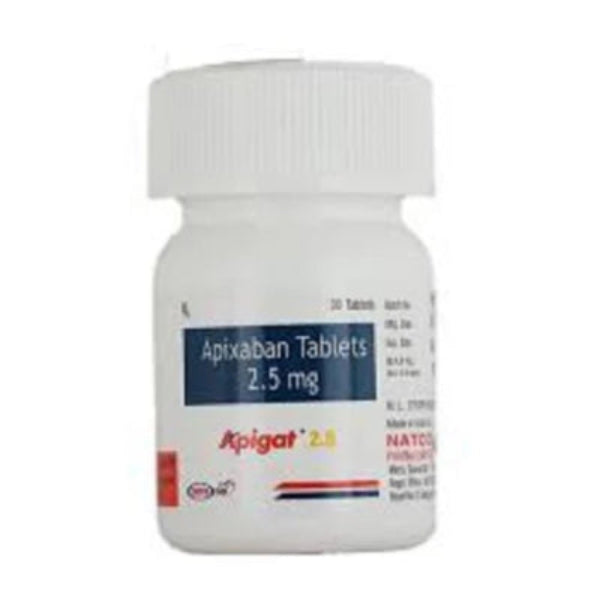


Apigat 2.5 mg (Apixaban)
Apigat 2.5 mg contains apixaban, an oral direct Factor Xa inhibitor (DOAC) used for prevention and treatment of venous thromboembolism (VTE) and for stroke prevention in specific clinical settings. Apixaban has proven efficacy for thromboprophylaxis after orthopaedic surgery and is used in multiple specialist-directed anticoagulation regimens.
Apigat is prescription-only. Initiation, dosing and duration of therapy should be directed by a clinician experienced in anticoagulation due to bleeding risks and important drug interactions.
Product introduction
Apixaban inhibits free and clot-bound Factor Xa and prothrombinase activity, reducing thrombin generation and clot formation. The 2.5 mg tablet strength is commonly used for specific indications — most notably thromboprophylaxis after hip or knee replacement surgery and dose-reduction scenarios in atrial fibrillation management where criteria are met.
Uses of Apigat 2.5 mg (Apixaban)
Common indications include (specialist-directed):
- Prevention of deep vein thrombosis (DVT) following hip replacement (typically 2.5 mg twice daily for ~35 days) or knee replacement (2.5 mg twice daily for ~12 days), started 12–24 hours postoperatively.
- Dose-reduction to 2.5 mg twice daily in atrial fibrillation patients meeting ≥2 of the following: age ≥80 years, body weight ≤60 kg, serum creatinine ≥1.5 mg/dL.
- Reduction in risk of recurrent DVT/PE after at least 6 months of treatment (2.5 mg twice daily maintenance in selected patients).
Note: Full indication set (treatment dosing, stroke prevention in NVAF, pediatric use, etc.) and dosing differs by indication — follow the prescribing information for each clinical setting.
Benefits of Apigat 2.5 mg (Apixaban)
- Oral administration: avoids routine parenteral anticoagulants for many prophylaxis and treatment pathways.
- Predictable pharmacokinetics: fixed dosing without routine coagulation monitoring in most patients.
- Evidence-based: superior or non-inferior efficacy vs conventional agents in orthopaedic prophylaxis and VTE studies.
Side effects of Apigat 2.5 mg (Apixaban)
The major risk with apixaban is bleeding; other adverse events are generally less common but important to monitor.
Common side effects
- Bleeding (minor to major; can include gastrointestinal bleeding)
- Epistaxis (nosebleeds)
- Bruising
- Rare hypersensitivity reactions
Serious risks: major or life-threatening bleeding (intracranial, gastrointestinal), and increased bleeding risk when combined with antiplatelet agents or strong CYP3A4/P-gp inhibitors. Seek urgent care for severe bleeding, fainting, sudden severe headache, or black/tarry stools.
How to use Apigat 2.5 mg (Apixaban)
- Follow your clinician’s dosing regimen exactly. For orthopaedic thromboprophylaxis the typical regimen is 2.5 mg orally twice daily, starting 12–24 hours after surgery.
- For atrial fibrillation, standard dosing is 5 mg twice daily with reduction to 2.5 mg twice daily in patients meeting dose-reduction criteria. Do not self-adjust doses.
- Swallow tablets whole with water; may be taken with or without food.
- Adherence is important — missed doses increase thrombotic risk; if a dose is missed, take as soon as possible on the same day and resume normal schedule. For twice-daily dosing, do not double doses.
- Inform all healthcare providers (surgeons, dentists) that you are taking apixaban before procedures — temporary interruption may be required.
How Apigat works
Apixaban is a reversible, direct inhibitor of Factor Xa. By inhibiting Factor Xa, it reduces thrombin generation and thrombus formation in the coagulation cascade. Its oral bioavailability and predictable effect permit fixed dosing without routine laboratory monitoring for most patients.
Safety advice
| Pregnancy / Breastfeeding | Apixaban should be used in pregnancy or breastfeeding only if clearly needed and after specialist consultation — anticoagulation in pregnancy often requires alternative agents such as LMWH. Refer to your clinician. |
| Renal impairment | Dose adjustments or caution needed in renal impairment; apixaban is partially renally eliminated — follow product labeling and clinician guidance. |
| Hepatic impairment | Apixaban is contraindicated in patients with hepatic disease associated with coagulopathy and clinically relevant bleeding risk. Specialist advice required. |
| Bleeding risk & procedures | Concomitant antiplatelet therapy (aspirin, clopidogrel), NSAIDs, SSRIs/SNRIs, or other anticoagulants increases bleeding risk — coordinate peri-procedural management with your clinician. |
| Drug interactions | Apixaban is a substrate of CYP3A4 and P-gp: strong dual inhibitors (e.g., ketoconazole, ritonavir) increase bleeding risk and may require avoidance or dose modification; inducers (e.g., rifampicin, carbamazepine) may reduce efficacy. Always provide a complete medication list to your clinician. |
| Reversal | In cases of major bleeding, andexanet alfa is an approved reversal agent in some regions; prothrombin complex concentrates (PCC) and supportive measures may be used where andexanet is unavailable — manage in hospital. |
What if you forget to take Apigat?
- If you miss a dose, take it as soon as you remember on the same day. Do not take two doses at once to make up for a missed dose. For twice-daily regimens, maintain spacing of roughly 12 hours between doses.
- If several doses are missed, contact your prescribing clinician—specialist advice may be needed.
All substitutes
Other oral anticoagulants and prevention/treatment options include:
- Other DOACs (rivaroxaban, dabigatran, edoxaban) — indication-dependent selection by clinician
- Low molecular weight heparin (LMWH) for certain perioperative or pregnancy indications
- Vitamin K antagonists (warfarin) where monitoring and reversal strategies are preferred
Choice of agent should be individualised by the treating clinician based on indication, renal function, drug interactions and patient preference.
Quick tips
- Carry an anticoagulation card and inform all care providers that you are taking apixaban.
- Avoid over-the-counter NSAIDs unless advised — they increase bleeding risk.
- Keep a current list of medications and supplements to review for interactions.
- Report any signs of bleeding, sudden severe headache, vision change, or fainting immediately.
Fact Box
| Generic name | Apixaban |
| Brand | Apigat 2.5 mg |
| Drug class | Oral direct Factor Xa inhibitor (DOAC) |
| Form | Oral tablet (2.5 mg) |
| Typical orthopaedic prophylaxis | 2.5 mg twice daily, start 12–24 hours after surgery (knee: 12 days; hip: 35 days) — confirm local protocol. |
| Prescription | Required — specialist/physician supervision |
Patient concerns
Will Apigat prevent clots completely? No anticoagulant eliminates all risk. Apixaban significantly reduces the risk of VTE and stroke in indicated settings but adherence and appropriate dosing are essential. Discuss residual risk and monitoring with your clinician.
What if I need surgery? Stop or adjust apixaban per your clinician’s instructions before elective procedures; timing depends on bleeding risk, renal function and procedure type. Do not stop without guidance.
User feedback
Patients commonly report convenience of oral dosing and reduced need for monitoring compared with warfarin; bleeding remains the primary concern and requires education and prompt reporting. Clinical monitoring and follow-up help maintain safety.
Are you currently taking Apigat 2.5 mg? Let us know how it is working for you by taking this survey.
FAQs
Can I take Apigat with aspirin?
Combining apixaban with antiplatelet agents increases bleeding risk. Only take concomitant antiplatelet therapy when specifically advised by your clinician (eg. after stenting).
Is there an antidote for Apigat?
Yes — andexanet alfa is an approved reversal agent in some regions for life-threatening bleeding; other measures (PCC, supportive care) may be used where andexanet is unavailable. Manage in hospital.
How should I store Apigat?
Store at room temperature away from moisture and heat. Keep out of reach of children and do not use after the expiry date.
Related products
- Other DOACs (rivaroxaban, dabigatran)
- LMWH for perioperative or pregnancy indications
- Compression stockings and mechanical prophylaxis where indicated
Want to share the information?
Share this article to help patients and clinicians understand apixaban therapy and safe use.
Disclaimer:
This content is educational only and does not replace professional medical advice. Apigat (apixaban) must be prescribed and monitored by qualified clinicians. For specific guidance follow your treating clinician and the product label.
References
- StatPearls — Apixaban pharmacology & clinical use.
- FDA Prescribing Information (ELIQUIS apixaban) — dosing, interactions, reversal.
- Eliquis (apixaban) HCP dosing guides — orthopaedic prophylaxis and VTE management.
- NHS — How and when to take apixaban (patient guidance).
- Mayo Clinic — apixaban patient information.
Marketer details
genericurerx — support@genericurerx.com — www.genericurerx.com
In case of any issues, contact us
For ordering or prescription verification use live chat or our contact page. For medical concerns contact your treating clinician immediately.
Lab tests offered by us
- Renal function tests (baseline and as indicated)
- Baseline and periodic hemoglobin / CBC if bleeding risk or suspected bleed
- Specialist coagulation advice and peri-procedural planning
Additional offers
Prescription coordination, anticoagulation counselling and monitoring support available on request. Use code GLOBAL10 where eligible for first-order discounts.







Reviews
There are no reviews yet.