
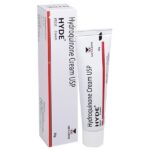
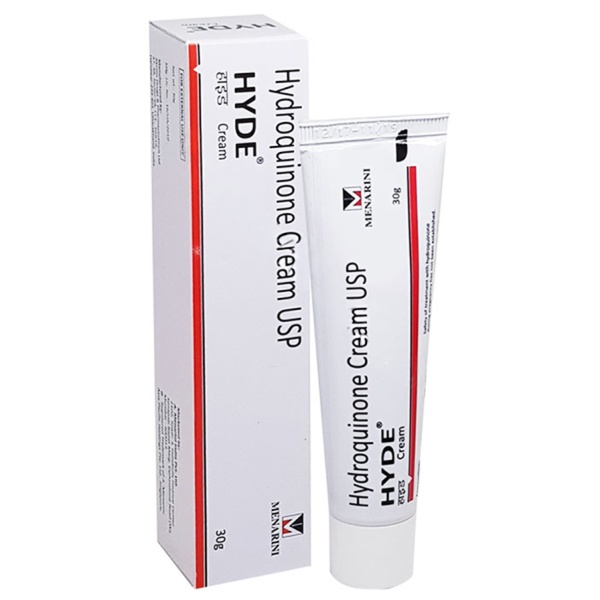

Hyde Cream (Hydroquinone)
Price range: 24.00$ through 42.00$
Hyde Cream (Hydroquinone) – Product Overview
Hyde Cream is a topical formulation containing hydroquinone 3% w/w, indicated for the treatment of hyperpigmentation disorders including melasma and post‑inflammatory hyperpigmentation. Manufactured by M
| Pack Size | Price | Quantity | |
|---|---|---|---|
| 1 Cream | 24.00$ | ||
| 3 Cream/s | 32.00$ | ||
| 6 Cream/s | 42.00$ |
Hyde Cream (Hydroquinone) – Product Overview
Hyde Cream is a topical formulation containing hydroquinone 3% w/w, indicated for the treatment of hyperpigmentation disorders including melasma and post‑inflammatory hyperpigmentation. Manufactured by Menarini India Pvt Ltd, each tube delivers 30 gm of cream intended for external use only. The product is packaged in a sealed, air‑tight tube to protect the active ingredient from light and oxidation. Storage at room temperature (15‑30 °C) is recommended; exposure to excessive heat may reduce potency. Hyde Cream complies with Indian Central Drugs Standard Control Organization (CDSCO) regulations and is registered under the Drug and Cosmetic Act, ensuring that it meets quality standards for safety and efficacy.
What is Hyde Cream?
Hydroquinone is a phenolic derivative that functions as a melanogenesis inhibitor by competitively blocking the enzyme tyrosinase, which catalyzes the conversion of tyrosine to dopa and subsequently to melanin. The 3% concentration in Hyde Cream provides a therapeutic window that balances efficacy with minimal systemic absorption. Although only a small fraction of the applied dose enters the systemic circulation, prolonged use requires periodic clinical review to monitor skin response and to detect any adverse reactions early. Pharmacologically, hydroquinone undergoes conjugation in the liver and is excreted primarily renally. Its topical application results in negligible plasma levels, making it suitable for patients who must avoid systemic depigmenting agents. The cream base is formulated with emollients and stabilizers that enhance skin penetration while reducing irritation potential.
Uses and Benefits
The primary indication of Hyde Cream is the reduction of excessive skin pigmentation. Clinically, it is employed to:
- Lighten facial melasma patches that often persist despite sunscreen alone.
- Improve the appearance of solar lentigines (age spots) and freckles.
- Treat post‑inflammatory hyperpigmentation resulting from acne, dermatitis, or cosmetic procedures.
- Provide a more uniform skin tone in individuals with chronic discoloration.
- Serve as an adjunct to broad‑spectrum sunscreen to prevent re‑pigmentation after UV exposure.
When used as part of a comprehensive skin‑care regimen, patients may experience visible lightening after 4‑6 weeks, with maximal improvement typically observed at 8‑12 weeks. The cream can be safely combined with moisturizers and sunscreens, enhancing overall skin barrier function. In some studies, adjunctive therapy with mild retinoids has shown additive depigmenting effects, though such combinations should be supervised by a dermatologist.
How It Works
Hydroquinone’s mechanism of action involves inhibition of tyrosinase, the rate‑limiting enzyme in melanin synthesis. By binding to the active site of tyrosinase, hydroquinone reduces the production of melanin granules within melanocytes. This leads to a gradual lightening of hyperpigmented lesions as existing pigment is cleared through normal epidermal turnover. The topical route limits systemic exposure, but the drug can still affect melanocyte activity locally, making it effective for localized hyperpigmentation.
Compared with other depigmenting agents such as azelaic acid or kojic acid, hydroquinone exhibits a more rapid onset of action and a higher potency at 3% concentration. However, its use is associated with a risk of ochronoderma and exogenous ochronosis with prolonged, unsupervised application, which underscores the importance of medical supervision.
Dosage Guidelines
Apply a thin layer of Hyde Cream to the affected area once daily, preferably in the evening after gentle cleansing. Before full‑face application, perform a patch test on a small skin area for 48 hours to assess tolerance. If no irritation occurs, proceed with regular use. Missed doses should be applied as soon as remembered; however, if it is nearly time for the next scheduled dose, the missed application should be skipped to avoid over‑use.
Treatment cycles generally span 8–12 weeks, followed by a maintenance phase in which the cream is used twice weekly to preserve results while minimizing irritation. Patients are advised to use a broad‑spectrum sunscreen with a minimum SPF 30 during daylight hours, as UV exposure can reverse the depigmenting effect and trigger recurrence of hyperpigmentation.
Side Effects
Most users experience mild, transient skin reactions that usually resolve without discontinuation. Common side effects include:
- Mild erythema (redness)
- Itching or a burning sensation
- Dryness or superficial peeling
Rare but serious adverse events may involve contact dermatitis, post‑inflammatory hyperpigmentation paradoxically worsening, or ochronoderma after months of misuse. If severe irritation, swelling, or discoloration persists, discontinuation of the product and consultation with a dermatologist are recommended. Long‑term safety data support intermittent use under professional guidance. Potential drug interactions are minimal due to limited systemic absorption, but caution is advised when using other topical agents that may increase skin absorption, such as corticosteroids or salicylic acid, as they could amplify irritation. Patients should inform their healthcare provider of all medications being used on the skin.
Warnings and Precautions
Hyde Cream is intended for external use only; avoid contact with the eyes, lips, or mucous membranes. Patients with known hypersensitivity to hydroquinone or any component of the formulation should not use the product. Pregnant or lactating women should seek medical advice before initiating therapy, as the safety of topical hydroquinone during these periods is not fully established. Concurrent use of other topical medications that increase skin permeability (e.g., strong exfoliants, retinoids) may enhance absorption and irritation; therefore, such combinations should be staggered and monitored. The product should be kept out of reach of children and stored in a cool, dry place away from direct sunlight. If accidental ingestion occurs, seek medical attention immediately.
Frequently Asked Questions
- Can Hyde Cream be used on all skin types? Yes, it is formulated for use on Fitzpatrick skin types I‑VI, but individuals with very sensitive skin should perform a patch test first and may start with a reduced frequency. It is also advisable to avoid applying the cream near the eyes and to keep the treated area clean to prevent secondary infections.
- How long does it take to see visible results? Most users notice improvement after 4‑6 weeks of consistent application, with maximal effect typically observed at 8‑12 weeks. Consistent daily use over the recommended period yields the best outcomes, and patients should be patient as pigmentation may regress gradually.
- Is it safe to combine Hyde Cream with other topical agents? It can be used alongside mild moisturizers or sunscreens, but avoid concurrent use with strong exfoliants or other depigmenting agents without dermatological guidance. When using in combination with sunscreen, apply the sunscreen at least 15 minutes before sun exposure to ensure optimal protection.
- What should I do if I miss a dose? Apply the missed application as soon as remembered; if it is near the time of the next dose, skip the missed dose and resume the regular schedule. If skin becomes overly dry, a gentle moisturizer can be used after the cream has fully absorbed.
- Where can I find more scientific information? For detailed pharmacology, refer to resources such as the National Center for Biotechnology Information, the U.S. Food and Drug Administration, or MedlinePlus. For the most up‑to‑date prescribing information, consult the product’s package insert or a pharmacist.
For additional details, see the Menarini global website or consult a qualified dermatologist.
Related Products
- Menarif 400 mg (Rifaximin)
- Otilonium Bromide 40mg (Generic)
- Eukroma Cream (Hydroquinone)
- Lioton 500 Gel (Heparin Sodium)
- Menoctyl 40mg (Otilonium Bromide)
- Scabper Cream 30g (Permethrin)
- Papulex Cream (Nicotinamide/Zinc)
- Papulex Cleansing Gel (Herbal)
- Scabper Lotion (Permethrin)
- Hyde Solution 50 ml (Hydroquinone)
- Cetrilak Mild Solution (Cetrimide)
- Fastum Gel (Ketoprofen)
Related Products
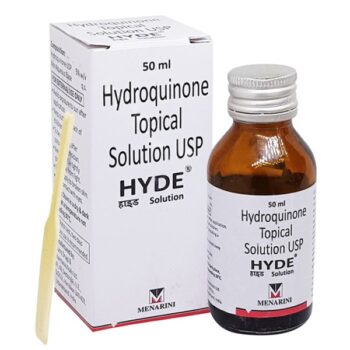
Hyde Solution 50 ml – 5 % Hydroquinone Product Overview Hyde Solution is a clinically formulated topical agent that contains 5 % hydroquinone, a well‑studied inhibitor of melanin synthesis. The product is supplied in a 50 ml amber glass bottle with a
In stock
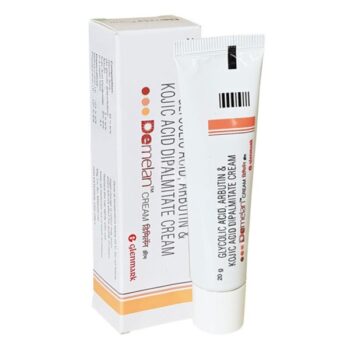
In stock

Product Overview Eukroma KJ Cream 20gm is a topically applied dermatological formulation designed to address moderate to severe forms of hyperpigmentation, including post‑inflammatory hyperpigmentation and melasma. The product is manufactured by Yash
In stock
Reviews
There are no reviews yet.