
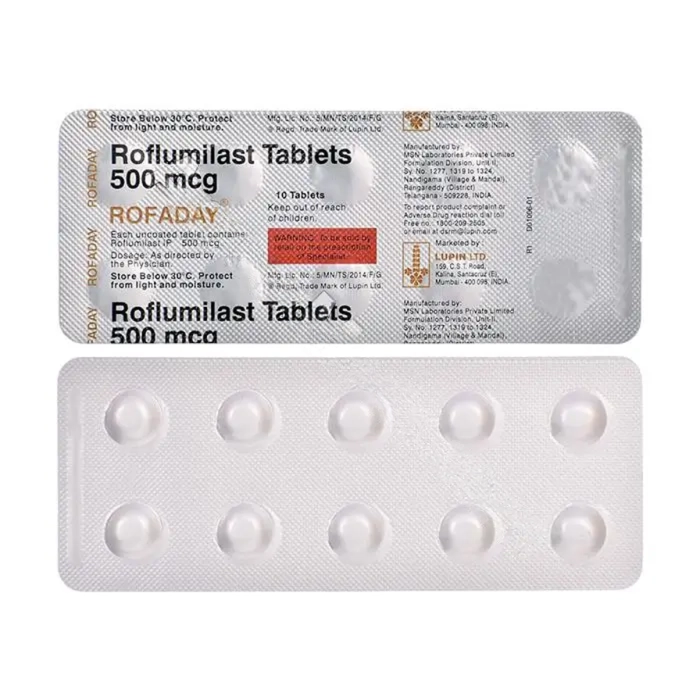
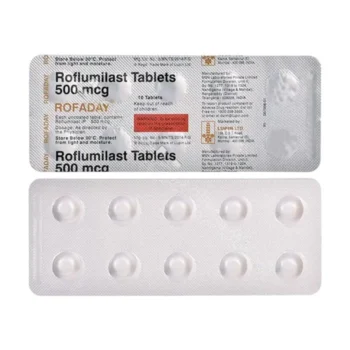
Rofaday 500 mcg Tablet (Roflumilast)
Price range: 70.00$ through 169.00$
Product Overview Rofiday 500 mcg Tablet, manufactured by Lupin Limited, contains the active ingredient roflumilast, a selective phosphodiesterase‑4 (PDE4) inhibitor used for long‑term maintenance of chronic obstructive pulmonary disease (COPD) in adu
| Active Ingredients | Roflumilast |
|---|---|
| Delivery Time | 6 To 15 days |
| Indication | Asthma, Chronic obstructive pulmonary disease (COPD) |
| Manufacturer | Lupin Limited |
| Packaging | 10 tablets in 1 strip |
| Strength | 500mcg |
| Pack Size | Price | Quantity | |
|---|---|---|---|
| 50 Tablet/s | 70.00$ | ||
| 100 Tablet/s | 108.00$ | ||
| 200 Tablet/s | 169.00$ |
Product Overview
Rofiday 500 mcg Tablet, manufactured by Lupin Limited, contains the active ingredient roflumilast, a selective phosphodiesterase‑4 (PDE4) inhibitor used for long‑term maintenance of chronic obstructive pulmonary disease (COPD) in adults who have had exacerbations. It is also indicated as an adjunct to inhaled corticosteroids for patients with asthma who remain symptomatic despite optimal inhaled therapy. Packaging options include blister packs of 10 tablets, with available pack sizes of 50, 100, and 200 tablets, allowing flexibility for chronic dosing regimens. Each tablet delivers a fixed dose of 500 micrograms roflumilast, ensuring consistent anti‑inflammatory coverage when taken once daily as prescribed by a healthcare professional.
What is Rofiday 500 mcg Tablet
Rofiday belongs to the class of phosphodiesterase‑4 inhibitors, which function by increasing intracellular cyclic AMP (cAMP) levels in airway cells. Inhibition of PDE4 reduces the degradation of cAMP, leading to downstream relaxation of bronchial smooth muscle and a reduction in the release of pro‑inflammatory cytokines, chemokines, and mediators such as histamine and leukotrienes. This biochemical effect translates into decreased airway inflammation and hyper‑responsiveness, helping to modify the underlying disease process rather than merely relieving symptoms. The drug is absorbed rapidly after oral administration, reaches steady‑state plasma concentrations after approximately one week of daily dosing, and has a terminal half‑life of about 50 hours, which supports once‑daily dosing. Pharmacokinetic studies have shown that mild to moderate renal impairment does not necessitate dose modification, whereas severe hepatic impairment (Child‑Pugh C) results in increased exposure and therefore warrants a dose reduction to 250 µg per day.
Uses and Benefits
The primary therapeutic use of Rofiday is to reduce the frequency and severity of COPD exacerbations, which are episodes of worsening respiratory symptoms that often lead to emergency department visits or hospitalizations. In large, multicenter clinical trials, patients receiving roflumilast experienced a statistically significant reduction in the rate of moderate or severe exacerbations compared with placebo, as well as a modest but measurable improvement in forced expiratory volume in one second (FEV1) after 24 weeks of treatment. For asthma, roflumilast is used as an add‑on therapy in patients who continue to experience symptoms despite the use of inhaled corticosteroids and long‑acting bronchodilators. In these studies, adjunctive roflumilast therapy was associated with fewer days of worsening respiratory symptoms and a lower need for oral corticosteroids. Because the medication targets the inflammatory component of disease pathogenesis, it can help preserve lung function over time, improve exercise tolerance, and potentially decrease the overall burden of inhaled rescue medication.
How It Works
At the molecular level, roflumilast inhibits the enzyme phosphodiesterase‑4, which normally hydrolyzes cyclic AMP (cAMP). When PDE4 is blocked, intracellular cAMP accumulates, leading to activation of protein kinase A and subsequent relaxation of airway smooth muscle. Elevated cAMP also dampens the activation of inflammatory cells, including neutrophils, macrophages, and eosinophils, resulting in reduced production of inflammatory mediators such as interleukin‑8, tumor necrosis factor‑α, and histamine. This dual action—airway smooth‑muscle relaxation combined with suppression of inflammatory signaling—makes roflumilast uniquely effective in modifying the chronic inflammatory state of COPD and severe asthma. The anti‑inflammatory effect is especially important in COPD, where persistent inflammation driven by cigarette‑smoke‑induced oxidative stress contributes to progressive airflow limitation and structural lung changes. By interfering with these pathways, Rofiday addresses the root cause of disease progression, offering a disease‑modifying option that complements traditional bronchodilator therapy.
Dosage Guidelines
Rofiday is administered as one 500 µg tablet taken orally once daily, preferably at the same time each day to maintain steady drug concentrations. The tablet may be taken with or without food; however, consuming it with a meal may help reduce gastrointestinal discomfort such as nausea or abdominal pain in some patients. In patients with severe hepatic impairment classified as Child‑Pugh C, the recommended dose should be reduced to 250 µg once daily, as hepatic dysfunction increases systemic exposure to the drug. If a dose is missed, the patient should take it as soon as remembered unless it is close to the time of the next scheduled dose; in that case, the missed dose should be skipped and the regular dosing schedule resumed. Doubling the dose to compensate for a missed tablet is not recommended. Patients should continue to use their prescribed short‑acting bronchodilators for acute symptom relief, as Rofiday is not intended for rescue therapy. Periodic assessment of lung function and clinical status is advised to determine the ongoing appropriateness of therapy.
Side Effects
Adverse events associated with roflumilax are generally mild to moderate and often diminish with continued treatment. The most frequently reported side effects include diarrhea (up to 15 % of patients), nausea, abdominal discomfort, headache, and nasopharyngitis (inflammation of the nasal passages). Less common but clinically important events include elevated serum transaminases, which necessitate periodic monitoring of liver function tests, and rare cases of eosinophilia, an increase in a type of white blood cell that may indicate an allergic response. Patients should be instructed to report persistent diarrhea, severe abdominal pain, or signs of liver dysfunction such as jaundice, dark urine, or unexplained fatigue. For comprehensive safety information, refer to the U.S. Food and Drug Administration (FDA), the National Institutes of Health (NIH), or MedlinePlus. In clinical practice, most patients tolerate the medication well, and the benefits of inflammation control often outweigh the modest side‑effect burden.
Warnings and Precautions
Rofiday is contraindicated in individuals with a known hypersensitivity to roflumilax or any of the tablet’s excipients. It should be avoided in patients with severe hepatic disease (Child‑Pugh C) unless the dose is reduced to 250 µg daily, due to increased drug exposure. Because roflumilax is metabolized primarily by the CYP3A4 enzyme, it may interact with strong inducers or inhibitors of this pathway; a thorough medication review is essential before initiating therapy. Pregnant women should use roflumilax only if the expected benefit justifies the potential risk, as animal studies have demonstrated adverse fetal outcomes at high exposures. Breastfeeding is not recommended while using the medication, as trace amounts may be present in milk. Clinicians must emphasize that Rofiday is not a rescue medication and should not be used to treat acute bronchospasm; patients should continue to carry a short‑acting inhaler for breakthrough symptoms. Abrupt discontinuation of therapy without medical supervision may lead to a rebound of inflammation and loss of therapeutic benefit, so any changes in dosing should be discussed with a healthcare provider.
Frequently Asked Questions
Q: Can Rofiday be used to treat an acute asthma attack?
A: No. It is a maintenance medication that works over weeks to reduce inflammation; acute symptoms require a rescue inhaler.
Q: How long does it take to see improvement in lung function?
A: Most patients notice a modest increase in lung function measurements after 4‑12 weeks of consistent daily use, with maximal benefit potentially taking several months.
Q: Is a dose adjustment needed for kidney disease?
A: No routine adjustment is required for mild to moderate renal impairment; however, safety data are limited in severe renal failure, so caution is advised.
Q: What should I do if I miss a dose?
A: Take the missed tablet as soon as you remember unless it is almost time for the next dose; then skip it and continue the regular schedule. Do not double the dose.
Q: Are there any dietary restrictions while taking Rofiday?
A: The tablet can be taken with or without food. If stomach upset occurs, taking it with a meal may help reduce nausea.
Related Products
- Pyzina 500 mg (Pyrazinamide)
- R-Cinex 600 Mg (Isoniazid/Rifampicin)
- Ethambutol 200mg (Generic)
- Pyrazinamide 500 mg (Generic)
- Nizonide (Nitazoxanide)
- Lupimeb 100 mg (Mebendazole)
- Nizonide 500 mg (Nitazoxanide)
- Nizonide DT 200mg (Nitazoxanide)
- Flugesic 100mg (Flupirtine)
- Abel 40 mg (Azilsartan Medoxomil)
- Cetil (Cefuroxime)
- Cetil 250mg (Cefuroxime)
Related Products
In stock
In stock
In stock
In stock
In stock
In stock
In stock
In stock
In stock
In stock
In stock
In stock
Reviews
There are no reviews yet.