Published by: GenaricCureRx
Updated: November 21, 2026
Category: Antiparasitic Medicines | Medication Guides
Ivermectin is a prescription antiparasitic medicine used to treat certain infections caused by worms and other parasites. One of the most common questions patients ask is: What is the correct ivermectin dosage for humans based on body weight?
The answer depends on several factors, including the type of parasitic infection, body weight, tablet strength, medical history, and treatment schedule.
For example, ivermectin is prescribed differently for intestinal strongyloidiasis, onchocerciasis (river blindness), and scabies.
This comprehensive guide from GenaricCureRx explains ivermectin dosage charts for humans by weight in kilograms and pounds, differences between 3mg and 12mg tablets, medical uses, possible side effects, and essential safety precautions.
Medical notice: The information in this article is educational and does not replace professional medical advice. The dosage charts describe published regimens for specific infections and must not be used to self-prescribe ivermectin.
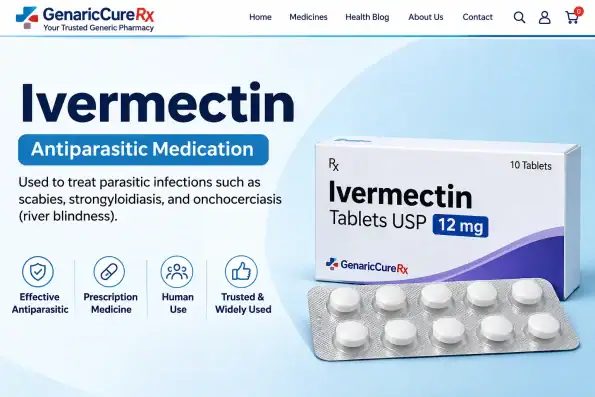
What Is Ivermectin?
Ivermectin is an antiparasitic medication belonging to the avermectin family of compounds.
It was developed from compounds derived from Streptomyces avermitilis, a soil-dwelling microorganism.
Ivermectin has been used for decades to treat certain human parasitic infections and plays an important role in international parasite-control programs.
In the United States, oral ivermectin is FDA-approved for two specific infections:
- Strongyloidiasis: An intestinal infection caused by Strongyloides stercoralis.
- Onchocerciasis: An infection caused by Onchocerca volvulus, also known as river blindness.
Doctors may prescribe ivermectin for other conditions, including scabies, when appropriate. Some such uses are off-label.
Specific topical ivermectin formulations are also used for head lice and rosacea.
How Does Ivermectin Work?
Ivermectin acts on certain nerve and muscle channels in susceptible parasites.
It binds primarily to glutamate-gated chloride channels, interfering with normal cellular signaling.
This action can paralyze susceptible parasites and help the body eliminate them.
Ivermectin does not work against every type of parasite, and it is not an all-purpose treatment for infections.
Its effectiveness depends on the organism being treated and the prescribed regimen.
Ivermectin Dosage Chart for Humans by Weight
Ivermectin dosing is commonly expressed in micrograms per kilogram of body weight (mcg/kg).
Different infections require different regimens.
For example:
| Medical Condition | Published Reference Dose | Treatment Considerations |
|---|---|---|
| Intestinal strongyloidiasis | Approximately 200 mcg/kg | FDA label describes a single dose; CDC guidance allows 1–2 days |
| Onchocerciasis | Approximately 150 mcg/kg | Single dose, with retreatment determined clinically |
| Classic scabies | 200 mcg/kg per dose | Two doses, 7–14 days apart, according to CDC guidance |
These are disease-specific clinical reference regimens, not general instructions for self-treatment.
Ivermectin 3mg Dosage Chart for Strongyloidiasis
The following chart is adapted from the U.S. prescribing information for Stromectol 3mg tablets.
It specifically describes the labeled single-dose regimen for intestinal strongyloidiasis.
| Body Weight (kg) | Approx. Body Weight (lbs) | Labeled Single Dose | Number of 3mg Tablets |
|---|---|---|---|
| 15–24 kg | 33–53 lbs | 3 mg | 1 |
| 25–35 kg | 55–77 lbs | 6 mg | 2 |
| 36–50 kg | 79–110 lbs | 9 mg | 3 |
| 51–65 kg | 112–143 lbs | 12 mg | 4 |
| 66–79 kg | 146–174 lbs | 15 mg | 5 |
| 80 kg and above | 176 lbs and above | Approximately 200 mcg/kg | Clinician-calculated |
Source: U.S. FDA-approved Stromectol prescribing information, reproduced on DailyMed.
https://dailymed.nlm.nih.gov/dailymed/drugInfo.cfm?setid=681888c9-af79-4b7d-ae80-c3f4f6f1effd
This table is not intended for scabies, COVID-19, or other conditions.
For patients weighing 80kg or more, the final dosage and suitable tablet combination must be calculated and confirmed by a healthcare professional.
Ivermectin Dosage Chart in Pounds (lbs)
In the United States, body weight is commonly recorded in pounds.
However, clinical ivermectin dosing references generally use kilograms.
The conversion formula is:
Body weight in kilograms = Body weight in pounds ÷ 2.20462
The following table provides approximate conversions.
| Body Weight (lbs) | Body Weight (kg) |
|---|---|
| 110 lbs | 49.9 kg |
| 132 lbs | 59.9 kg |
| 154 lbs | 69.9 kg |
| 176 lbs | 79.8 kg |
| 198 lbs | 89.8 kg |
| 220 lbs | 99.8 kg |
These conversions help readers understand medical dosing references. They do not determine the correct prescription.
Ivermectin Dosage for Strongyloidiasis
Strongyloidiasis is an intestinal infection caused by the roundworm Strongyloides stercoralis.
Some infected individuals experience abdominal discomfort, diarrhea, skin symptoms, or other gastrointestinal problems.
Others may have few noticeable symptoms.
The infection can become particularly dangerous in people receiving immunosuppressive treatment.
Recommended Clinical Regimen
The CDC identifies ivermectin as a first-line treatment for uncomplicated strongyloidiasis.
Its published regimen is:
200 mcg/kg orally for 1–2 days.
The U.S. Stromectol prescribing information describes an approximately 200 mcg/kg single oral dose.
Patients with severe or disseminated infections require specialized treatment and medical monitoring.
Follow-up testing may be necessary to confirm successful treatment.
Medical reference:
https://www.cdc.gov/strongyloides/hcp/clinical-care/
Ivermectin Dosage for Onchocerciasis (River Blindness)
Onchocerciasis is a parasitic infection caused by Onchocerca volvulus.
It is transmitted through the bites of infected blackflies.
The disease may cause itching, skin changes, and potentially serious eye complications.
Recommended Clinical Regimen
The FDA-approved prescribing information describes:
Approximately 150 mcg/kg as a single oral dose.
Additional treatments may be necessary because ivermectin primarily affects the parasite’s microfilariae rather than eliminating adult worms.
Treatment programs frequently use repeated dosing at intervals established by public health authorities.
For individual patients, retreatment frequency is determined by the treating specialist.
Patients who may have Loa loa co-infection require special evaluation because severe neurological reactions are possible.
Ivermectin Dosage for Scabies
Scabies is a contagious skin infestation caused by microscopic mites called Sarcoptes scabiei.
Common symptoms include:
- Severe itching, especially at night
- Small red bumps or rash
- Skin irritation
- Thin burrow-like lines
- Itching between fingers or around wrists
- Persistent discomfort after close skin contact
Oral Ivermectin for Scabies
According to the CDC, oral ivermectin used for classic scabies is generally prescribed as:
200 mcg/kg per dose, repeated after 7–14 days.
Oral ivermectin for scabies is an off-label use in the United States.
The second dose helps address mites that may hatch after the first treatment.
For scabies, CDC guidance recommends taking oral ivermectin with food.
This differs from the empty-stomach instructions in the FDA label for certain other parasitic infections.
Does Ivermectin Cure Scabies Permanently?
Successful treatment can eliminate a scabies infestation, but reinfestation is possible.
Medical treatment may also involve:
- Treating close contacts when recommended
- Washing or isolating relevant clothing and bedding
- Following prescribed topical treatment instructions
- Avoiding close skin contact until appropriate treatment has begun
- Seeking medical review if symptoms persist or worsen
Itching can continue temporarily even after successful treatment.
What About Crusted Scabies?
Crusted scabies is a severe and highly contagious form of the infestation.
It often requires a combination of oral and topical medications under specialist supervision.
Patients should not attempt to treat crusted scabies using an ordinary scabies schedule without medical advice.
Medical reference:
https://www.cdc.gov/scabies/hcp/clinical-care/
Ivermectin 3mg vs 6mg vs 12mg Tablets
Ivermectin is manufactured in different tablet strengths depending on the country, manufacturer, and regulatory approval.
| Tablet Strength | Active Ingredient | Important Consideration |
|---|---|---|
| Ivermectin 3mg | 3mg ivermectin | Used in the U.S. reference dosing chart |
| Ivermectin 6mg | 6mg ivermectin | Availability and approval vary by country |
| Ivermectin 12mg | 12mg ivermectin | Requires an appropriate prescription and formulation |
Is Ivermectin 12mg Stronger Than 3mg?
Yes. A 12mg tablet contains four times the amount of active ingredient in a 3mg tablet.
However, the higher strength is not automatically more effective or more appropriate.
The correct dosage depends on body weight, diagnosis, and the specific prescription.
Patients should never replace one tablet strength with another without approval from their prescriber or pharmacist.
How Should Ivermectin Be Taken?
Instructions vary depending on the prescribed indication and formulation.
For FDA-labeled oral treatment of strongyloidiasis and onchocerciasis, ivermectin tablets are taken on an empty stomach with water.
For oral scabies treatment, CDC guidance recommends taking ivermectin with food.
Because administration directions differ, patients should carefully follow the instructions for their prescribed treatment.
General safety recommendations include:
- Use only human medication prescribed for you.
- Confirm the correct tablet strength.
- Follow the prescribed treatment schedule.
- Do not increase the dose independently.
- Inform your doctor about other medicines.
- Never use veterinary ivermectin formulations.
- Attend recommended follow-up appointments.
Common Side Effects of Ivermectin
Like all prescription medicines, ivermectin may cause side effects.
Some commonly reported or possible effects include:
- Nausea
- Diarrhea
- Stomach discomfort
- Dizziness
- Headache
- Tiredness
- Skin itching
- Rash
The symptoms and their frequency may differ depending on the infection being treated.
Some inflammatory reactions may occur as parasites die.
Contact a healthcare professional if symptoms are persistent, concerning, or worsening.
Serious Ivermectin Side Effects
Although ivermectin has established medical uses, serious adverse reactions can occur.
Seek urgent medical assistance for:
- Seizures
- Severe confusion
- Loss of consciousness
- Difficulty breathing
- Severe allergic reactions
- Significant coordination problems
- Severe neurological symptoms
Patients with certain parasitic co-infections may be at greater risk of complications.
Ivermectin overdose can cause dangerous toxicity.
Never take more than prescribed.
Important Safety Precautions
Pregnancy
Ivermectin safety information during pregnancy is limited.
Pregnant patients should receive individualized medical advice before treatment.
Breastfeeding
Ivermectin can pass into breast milk.
A doctor should assess the benefits and risks of treatment.
Children Weighing Less Than 15kg
Evidence regarding oral ivermectin use in children below 15kg is limited.
Specialist medical evaluation is required.
Liver Conditions
Patients with liver-related medical conditions should inform their prescriber.
Other Medicines
Drug interactions may affect treatment safety.
For example, patients taking warfarin should inform their prescriber because additional monitoring may be necessary.
Can Ivermectin Be Used for COVID-19?
Ivermectin is not FDA-approved or authorized to prevent or treat COVID-19.
Major clinical studies have not established a clinically meaningful benefit for treating COVID-19.
Patients should not use ivermectin instead of established COVID-19 treatments recommended by qualified healthcare professionals.
FDA reference:
https://www.fda.gov/consumers/consumer-updates/ivermectin-and-covid-19
Is Ivermectin Safe for Human Use?
Human ivermectin can be used safely for appropriate medical indications when prescribed correctly.
However, its safety depends on factors including:
- Correct diagnosis
- Appropriate prescription
- Body weight
- Patient age
- Medical history
- Other medications
- Risk of drug interactions
- Treatment monitoring
Veterinary ivermectin products are not suitable substitutes for human medications.
Animal formulations may contain concentrations or ingredients that can cause serious harm.
Ivermectin Medicine Information at GenaricCureRx
At GenaricCureRx, readers can explore information about generic medicines and learn about different pharmaceutical formulations.
Understanding tablet strengths, active ingredients, approved indications, and precautions can help patients have more informed conversations with healthcare professionals.
Before obtaining any prescription medication, patients should confirm that it is appropriate for their medical condition and legally supplied in their jurisdiction.
For more information about generic medicines, visit:
Frequently Asked Questions About Ivermectin Dosage
1. What is the standard ivermectin dosage for humans?
There is no universal dose for every condition. The published regimen for intestinal strongyloidiasis is approximately 200 mcg/kg, while onchocerciasis uses approximately 150 mcg/kg. A healthcare professional must determine the correct regimen.
2. How is ivermectin dosage calculated by body weight?
Clinicians use body weight in kilograms and the dose recommended for the diagnosed infection. They then select a suitable tablet regimen based on the relevant prescribing information.
3. Is ivermectin 12mg suitable for humans?
Human ivermectin products containing 12mg are marketed in some countries. Whether that tablet strength is appropriate depends on the prescription, product approval, and medical circumstances.
4. How often should ivermectin be taken?
Treatment frequency depends on the infection. Some regimens use a single dose, while others require repeated treatment. Do not repeat ivermectin without medical direction.
5. Can ivermectin be used for scabies?
Yes. Oral ivermectin is used off-label for scabies in the United States. CDC guidance recommends two doses, 7–14 days apart, when oral treatment is appropriate for classic scabies.
6. Should ivermectin be taken with or without food?
The answer depends on the condition being treated. FDA-labeled oral regimens for strongyloidiasis and onchocerciasis specify an empty stomach, while CDC guidance for oral scabies treatment recommends taking it with food.
7. How long does ivermectin take to work?
Ivermectin begins acting against susceptible parasites after administration, but symptom improvement and confirmation of successful treatment vary by infection.
8. Can ivermectin be taken every day?
Routine daily use is not appropriate for most commonly treated infections. Certain severe infections may require specialized regimens under close medical supervision.
9. Is ivermectin safe for everyone?
No. Ivermectin may be unsuitable for some patients, including those with particular health conditions, contraindications, or medication interactions.
10. Can ivermectin cause neurological side effects?
Yes. Although uncommon with appropriate use, serious neurological reactions have been reported, particularly with overdose and certain underlying conditions.
11. Is ivermectin FDA-approved for COVID-19?
No. The FDA has not approved or authorized ivermectin for treating or preventing COVID-19.
12. Can a person use an ivermectin dosage chart without consulting a doctor?
No. Dosage charts are general educational references. They do not account for individual medical conditions, contraindications, or other treatment considerations.
Conclusion
Understanding the ivermectin dosage chart for humans by weight can help patients better understand how this antiparasitic medication is prescribed.
However, the correct ivermectin regimen depends on more than body weight.
Different parasitic infections require different doses and treatment schedules, and some uses require additional monitoring.
Whether a patient is researching ivermectin 3mg tablets, 12mg formulations, scabies treatment, or other antiparasitic therapies, professional medical guidance is essential.
For additional educational information about generic medicines and pharmaceutical products, visit GenaricCureRx.
Website: https://genariccurerx.com/
Medical References
- DailyMed — Stromectol (Ivermectin) Prescribing Information
https://dailymed.nlm.nih.gov/dailymed/drugInfo.cfm?setid=681888c9-af79-4b7d-ae80-c3f4f6f1effd - CDC — Clinical Care of Strongyloides
https://www.cdc.gov/strongyloides/hcp/clinical-care/ - CDC — Clinical Care of Scabies
https://www.cdc.gov/scabies/hcp/clinical-care/ - FDA — Ivermectin and COVID-19
https://www.fda.gov/consumers/consumer-updates/ivermectin-and-covid-19
Medical Disclaimer
This article is published by GenaricCureRx for educational and informational purposes only. It does not constitute medical advice, diagnosis, or treatment recommendations. Ivermectin should only be used according to a valid prescription and professional medical guidance. Never calculate or select your own dosage using an online chart. Consult a licensed healthcare professional about your individual health needs, potential side effects, contraindications, and drug interactions.